
Prospek 2016: Pasokan Cabai dan Bawang Terjamin, dan Harga Stabil
Indonesian Horticultural Production Outlook 2016
Editor : M. Achsan Atjo
Translator : Dhelia Gani
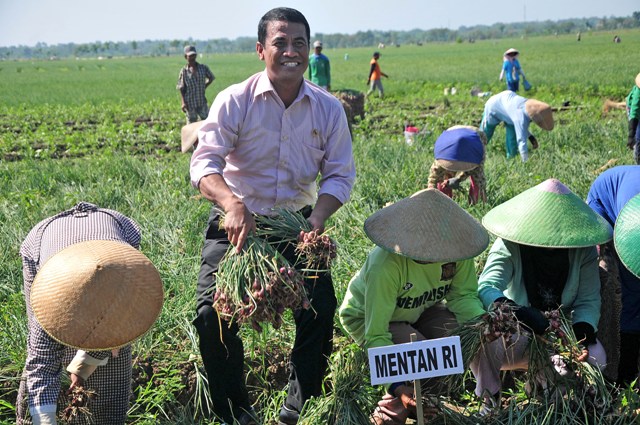
Oleh: Andi Amran Sulaiman, Menteri Pertanian RI
MENGURAI penyebab lonjakan harga cabai dan bawang merah tidaklah sederhana. Tidak bisa hanya dilihat dari pergerakan harga dalam satu dua hari saja, namun harus dilihat dalam kurun waktu panjang. Kedua komoditas ini dalam waktu tertentu pernah jatuh dan petani menderita rugi. Namun pada saat tertentu harga melonjak tinggi. Berbeda dengan komoditas lainnya, karakteristik cabai dan bawang merah yang mudah rusak (perishable) dan fluktuasi harganya berkontribusi terhadap inflasi, sehingga pemerintah memberi perhatian serius.
Stabilitas harga cabai dan bawang merah di Jakarta dapat dengan mudah dideteksi dari jumlah pasokan ke Pasar Cibitung, Bekasi, Jawa Barat. Apabila tiap hari mampu memasok minimal 40 truk masuk ke pasar ini maka diyakini harga akan turun dan stabil, sebaliknya bila pasokan kurang dari 25 truk, maka harga akan merangkak naik.
Fluktuasi harga komoditas ini bukan karena kekurangan pasokan, melainkan karena pengaturan kontinuitas pasokan antarwilayah sentra cabai. Tiga jenis cabai memiliki karakteristik berbeda, (1) jenis cabai besar untuk industri berkontribusi 20% dari total produksi, harganya relatif stabil; (2) cabai keriting berkontribusi 50% dari total produksi sedikit berfluktuasi, dan (3) jenis cabai rawit kontribusi 30% dari total produksi ini harganya berfluktuasi. Kurva harga cabai berbentuk huruf U ini dimana harga rendah saat kemarau karena panen cabai berbarengan. Hal ini diatasi dengan pengaturan pola tanam, produksi dan rantai pasoknya.
Guna memenuhi pasokan secara cukup dan kontinu, Kementan secara cermat menghitung sebaran produksi berdasarkan geo-spasial dan dimensi waktu sehingga menjamin pasokan setiap hari dan telah dirancang kesiapan produksi harian/mingguan sampai dengan akhir tahun 2016. Seperti diketahui di delapan kota besar di Indonesia membutuhkan pasokan 48% dari total kebutuhan konsumsi nasional cabai merah besar; 24,8% cabai rawit dan 33% bawang merah. Untuk itu lokasi pengembangan sentra produksinya diarahkan tidak terlalu jauh dari pusat kota besar.
Berdasarkan siklus tahunan, harga bawang merah akan naik pada saat musim hujan di wilayah sentra andalannya seperti Brebes dan Majalengka saat hujan sedang menyiapkan lahannya untuk tanam padi. Mengatasi hal tersebut, Kementan sejak 2015 secara sistemik dikembangkan bawang merah besar-besaran minimal 1.000 ha di wilayah sentra lain yang tersebar di Bima, Sumbawa, Tapin, Enrekang, Pesisir Selatan, Kampar, Nganjuk, Probolinggo dan lainnya.
Pengaturan pola tanam, panen dan rencana produksi secara bulanan selama 2016 dengan target luas 129 ribu hektar telah dipetakan, perkiraan produksi 1,29 juta ton tersebar di sentra produksi bawang merah di Pulau Jawa akan memasok 73% dari total kebutuhan, Bali Nusa Tenggara 15% dan sisanya di Sumatera, Sulawasi dan lainnya. Demikian juga guna memenuhi kebutuhan cabai di Seluruh Indonesia sekitar 150 ribu ton per hari ini, bila selama ini produksi cabai bertumpu pada musimnya.
Selama ini bulan November-Maret pasokan berkurang, maka kini Kementan membuat terobosan mengembangkan cabai di luar musim (off season) yang dilengkapi dengan pompa air dan irigasi tetes, serta dipusatkan di Jawa Barat, dan Banten, diyakini akan mampu memasok kebutuhan Jabodetabek secara berkelanjutan. Pertimbangan geo-spasial dan waktu tanam dikembangkan cabai di sekitar Jabodetabek ini mengingat karakteristik cabai perishable dan konsumen menghendaki cabai segar sehingga cabai harus dipanen setiap pagi hari dan sore harinya sudah masuk ke pasar.
Direncanakan akan ditanam cabai besar 2016 seluas 152 ribu ha dn cabai rawit 188 ribu ha dengan perkiraan produksi 1,2 juta ton dan 940 ribu ton terdiri dari sentra di Pulau Jawa sebesar 51%; Sumatera 17%, Sulawesi 4% dan sisanya dipasok dari wilayah lainnya.
Daya tahan cabai segar hanya satu-tiga hari saja, semakin rendah kesegaran semakin jatuh harganya. Kementan memberikan solusi sistemik ini sekaligus juga untuk menekan disparitas harga cabai tinggi antara harga di petani dan di pasaran akibat susut hasil dan kerusakan cabai selama perjalanan ke pasar dan dari pasar ke konsumen.
Hal ini berbeda dengan bawang merah tidak terdapat disparitas harga yang terlalu jauh, mengingat bawang merah lebih tahan simpan dan tingkat penyusutan lebih rendah.
Komoditas cabai dapat dikembangkan di setiap jengkal lahan, Untuk itu agar Pemda Kabupaten/Kota juga mendorong pengembangan cabai di setiap lahan warga tersedia, di pekarangan rumah dan lainnya, sehingga mampu mencukupi kebutuhan cabai secara mandiri dan tidak bergantung pada daerah lain.
Asosiasi Agribisnis Cabe Indonesia (AACI) pun bersepakat dengan petani, Kepala Desa dan Camat bersama penyuluh untuk menata pola tanam cabai setiap harinya, sehingga ada sejenis kalender tanam cabai di sentra cabai level desa, kecamatan, maupun kabupaten yang dikoordinasikan oleh Pemda setempat.
Selanjutnya agar swasta berinvestasi di cabai dan bawang merah dengan sistem contract farming, mengingat “pedes”nya harga cabai dan bawang merah juga akibat permintaan industri yang waktu lalu sebagian dipenuhi dari impor.
Hal yang perlu mendapat perhatian juga adalah pada sisi konsumen. Diperlukan perubahan kebiasaan konsumen, dari biasa mengkonsumsi cabai segar berpindah selera menjadi cabai kering tanpa merubah cita rasa sebagaimana yang telah berhasil dilakukan di India.
By: Andi Amran Sulaiman, Indonesian Agriculture Minister
UNRAVEL the causes of the rising price of chilies and shallots are not simple. It can not only from price movements in one or two days, but it should be seen in a long period. The price of commodities is decreasing in a certain time and the farmers lose money. But at certain moments the price soaring. Differences with other commodities, the characteristics of peppers and shallots are classified as perishable and fluctuating prices contribute to inflation, so that the attention of the government.
Price stability of chili and shallots in Jakarta can be easily detected from the supply to the market Cibitung in Bekasi district of West Java province. When every day is able to supply a minimum of 40 trucks into this market can be assured the price will go down, but if the supply is less than 25 trucks, the price of these commodities will rise.
Fluctuations in commodity prices is not only due to lack of supply, but because of supply continuity of chilli production centers. Three types of chilli have different characteristics, (1) contribution of the great chilli for about 20% of the industry total production so the price is relatively stable; (2) chilli curls contribution of 50% of the total production is quite fluctuating, and (3) the contribution of cayenne pepper 30% of total production costs fluctuate. Price curve is U-shaped chilli, when the price of chilli low in the dry season because the harvest is done simultaneously. This obstacle overcome by arranging the pattern of cultivation, production and supply chain.
In order to meet the continuous supply, the Indonesian Agriculture Ministry calculate in detail the distribution of production based geo-spatial and time dimensions to ensure the daily supply, and designing supply daily or weekly until the end of 2016. As is known eight major cities in Indonesia need supplies 48% of total consumption needs nationally for the big red chilli; 24.8% cayenne pepper, and 33% shallots. The Ministry decides location production centers close to consumption centers.
Based on an annual cycle, onion prices will rise during the rainy season in production centers such as Brebes and Majalengka when farmers are preparing land for rice planting. To anticipate this, the ministry since 2015 systemically develop centers of at least 1,000 hectares shallots in other production centers such as Bima, Sumbawa, Tapin, Enrekang, South Coast, Kampar, Nganjuk, Probolinggo and others.
Setting a pattern of planting, harvest period and plans monthly production in 2016 with a target of 129,000 hectares area has been mapped, the estimated production of 1.29 million tonnes in shallots production centers in Java will supply 73% of the total requirement in Bali, Nusa Tenggara 15% and rest in Sumatra, Sulawesi and others. Similarly, to meet the needs of chilli across Indonesia around 150,000 tons per day, because production rests on the season.
During this time, especially from November to March the supply decreases, the ministry made a breakthrough to develop the production of off season powered water pumps and drip irrigation for farmers, which is centered in West Java and Banten, believed to be capable of supplying the needs of Jakarta and surrounding areas in a sustainable manner. Consider geospatial information, and the growing season around Jakarta considering the characteristics of chilli as perishable crops, and consumers want fresh chilli and should be harvested twice a day, and must have entered into the market in the afternoon.
The government plans for 2016 will be planted large chili on 152,000 hectares of land, and cayenne pepper 188,000 hectares with an estimated production of 1.2 million tons and 940,000 tons, the supply of Java is expected to reach 51%; 17% of Sumatra, 4% of Sulawesi and the rest supplied from other regions.
Durability fresh chilli only one to three days, the lower the freshness of more depreciate. Ministry provide systemic solutions as well as to suppress the price disparity in the level of the farmer and the market as a result of shrinkage of results, and the level of damage during a trip to the market, and from market to consumers. Unlike the red onion price disparity is not too far, because shallots over can be retained, and a lower depreciation rate.
Chili as a commodity to be developed in every inch of land, the local government to encourage the development of chilli in every area of its citizens, both in the yard and the other so-sufficient independently without depending on supply from other regions.
Indonesian Chilli Agribusiness Associations or ACCI also agreed with farmers, village and subdistrict heads with agricultural extension workers to organize planting patterns chilli every day, so there is a kind of chilli planting calendar in centers of rural areas, districts, and counties are coordinated by the local government.
Furthermore, involve the private sector to invest in chilli and shallots with contract farming system, due to fluctuations in the price of pepper and shallots in the past due to the demand for more met by imports.
Things that need attention are the needs of consumers so that the necessary changes in consumer habits, from consuming fresh chilli chilli switch to dry without changing the taste as successfully carried out by India.