Al Gore `Mengigau`, Es di Kutub Utara Malah Meluas
Al Gore`s Prediction it Would be Ice-free by Now was Bogus Prediction
Editor : Ismail Gani
Translator : Novita Cahyadi
TUJUH tahun setelah pidato mantan Wakil Presiden AS, Al Gore bahwa luas es di kutub utara akan menyusut akibat pemanasan global ternyata tidak terbukti.
Sebuah kawasan di kutub utara yang luasnya dua kali Alaska - negara bagian terbesar AS - dua tahun lalu menjadi lautan dan kini tertutup es.
Citra satelit yang dirilis dari University of Illinois´s Cryosphere memperlihatkan luas kawasan yang tertutup es malah meluas, seperti dilansir MailOnline.
Pidato Al Gore kini digolongkan sebagai pemicu ketakutan yang tidak terbukti. ´Kutub Utara meleleh dan gunung es akan runtuh," katanya. "Fakta mengerikan itu akan terjadi pada musim panas tujuh tahun dari sekarang. "
Pernyataan itu dilontarkannya pada 2007 dan sebagai ´imbalannya´ Al Gore menerima Hadiah Nobel Perdamaian untuk kampanye tentang perubahan iklim.
Namun tujuh tahun setelah peringatannya itu, MailOnline mengungkap bahwa peringatannya tidak terbukti, luas es Arktik malah meluas dalam dua tahun terakhir - secara bertahap, tergantung pada bagaimana Anda mengukurnya, antara 43% hingga 63% sejak 2012.
Dengan kata lain, sebuah wilayah seluas Alaska, negara bagian terbesar di Amerika, adalah perairan terbuka dua tahun lalu, namun sekarang tertutup oleh es.
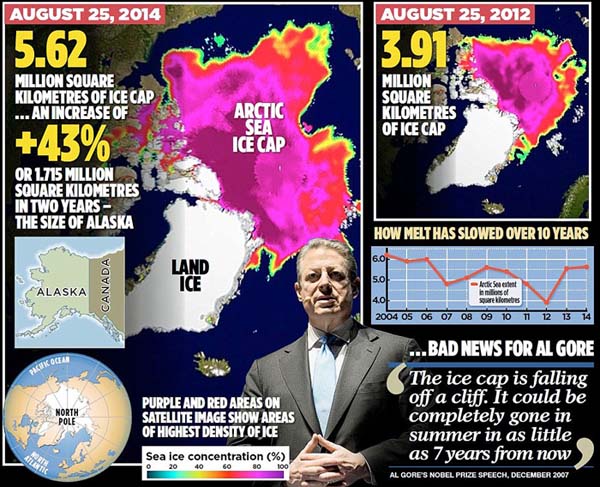
Yang paling banyak digunakan untuk pengukuran es di Arktik adalah dari laporan harian citra satelit yang diterbitkan oleh US National Snow and Ice Data Center, yang didanai oleh NASA. Ini menunjukkan bahwa - sementara tren jangka panjang masih menunjukkan penurunan - Senin lalu, 25 Agustus, wilayah Samudra Arktik dengan setidaknya 15% lapisan es adalah 5,62 juta kilometer persegi.
Ini adalah tingkat tertinggi yang tercatat pada tanggal tersebut sejak 2006, dan merupakan peningkatan dari 1,71 juta kilometer persegi selama dua tahun terakhir - yang meningkat hingga 43%.
Fakta ilmiah lain dikemukakan Institut Meteorologi Denmark yang memperkirakan pertumbuhan lebih dramatis. Menggunakan ukuran yang berbeda, kawasan yang dilapisi es sekitar 30%, atau meningkat 63% - dari 2,7 juta km menjadi 4,4 juta km.
Citra satelit yang dipublikasikan di sini diambil dari sumber otoritatif lebih lanjut, University of Illinois proyek Cryosphere ini.
Tokoh lainnya dari Denmark Meteorologi Institut menunjukkan bahwa pertumbuhan telah bahkan lebih dramatis. Menggunakan ukuran yang berbeda, daerah dengan setidaknya 30 persen lapisan es, ini mengungkapkan kenaikan persen 63 per - 2700000-4400000 kilometer persegi.
Mereka menunjukkan bahwa luas area tertutup es menjadi lebih luas, berkembang lebih terkonsentrasi, dengan daerah ungu - yang menunjukkan daerah di mana es yang paling padat - meningkat tajam.
Hal penting lain, ketebalan es juga meningkat, dan karena itu lebih tahan terhadap pemanasan global di masa-masa mendatang. Profesor Andrew Shepherd, dari Leeds University dan Universitas Coillege, London, pakar pemantauan satelit iklim, mengatakan: "Jelas dari pengukuran yang kami kumpulkan bahwa es laut Arktik telah mengalami pemulihan yang signifikan dalam ketebalan selama tahun lalu.
"Tampaknya musim panas sangat dingin pada tahun 2013 memungkinkan lebih banyak es untuk bertahan daripada musim dingin lalu. Ini berarti bahwa es laut Kutub Utara lebih tebal dan lebih kuat dari biasanya, dan ini harus diperhitungkan ketika membuat prediksi tingkat masa depan."
Judith Curry, profesor bumi dan atmosfer ilmu di Georgia Institute of Technology di Atlanta, berujar: ´Laut es di Kutub Utara yang dibilang meleleh ternyata mengeras dan menebal serta meluas."
Mereka yang beberapa tahun lalu memperingatkan bahwa musim panas pada 2014 sebagai ancaman serius, termasuk dari Menteri Luar Negeri AS John Kerry, yang membuat prediksi palsu yang sama pada 2009, sementara Al Gore mengulangi berkali-kali - terutama dalam pidatonya kepada para pemimpin dunia di konferensi iklim PBB di Kopenhagen pada 2009, dalam upaya membujuk mereka untuk menyetujui perjanjian emisi baru.
Mr Gore - yang gagal dihubungi di kantornya untuk dimintai tanggapannya - bersikeras kemudian: ´Ada 75 persen kemungkinan bahwa seluruh es di kutub selama beberapa musim panas bisa benar-benar bebas es dalam waktu lima sampai tujuh tahun.´
SEVEN years after former US Vice-President Al Gore´s warning, Arctic ice cap has expanded for second year in row.
An area twice the size of Alaska - America´s biggest state - was open water two years ago and is now covered in ice.
These satellite images taken from University of Illinois´s Cryosphere project show ice has become more concentrated
The speech by former US Vice-President Al Gore was apocalyptic. ‘The North Polar ice cap is falling off a cliff,’ he said. ‘It could be completely gone in summer in as little as seven years. Seven years from now.’
Those comments came in 2007 as Mr Gore accepted the Nobel Peace Prize for his campaigning on climate change.
But seven years after his warning, The Mail on Sunday can reveal that, far from vanishing, the Arctic ice cap has expanded for the second year in succession – with a surge, depending on how you measure it, of between 43 and 63 per cent since 2012.
To put it another way, an area the size of Alaska, America’s biggest state, was open water two years ago, but is again now covered by ice.
The most widely used measurements of Arctic ice extent are the daily satellite readings issued by the US National Snow and Ice Data Center, which is co-funded by Nasa. These reveal that – while the long-term trend still shows a decline – last Monday, August 25, the area of the Arctic Ocean with at least 15 per cent ice cover was 5.62 million square kilometres.
This was the highest level recorded on that date since 2006, and represents an increase of 1.71 million square kilometres over the past two years – an impressive 43 per cent.
Other figures from the Danish Meteorological Institute suggest that the growth has been even more dramatic. Using a different measure, the area with at least 30 per cent ice cover, these reveal a 63 per cent rise – from 2.7 million to 4.4 million square kilometres.
The satellite images published here are taken from a further authoritative source, the University of Illinois’s Cryosphere project.
They show that as well as becoming more extensive, the ice has grown more concentrated, with the purple areas – denoting regions where the ice pack is most dense – increasing markedly.
Crucially, the ice is also thicker, and therefore more resilient to future melting. Professor Andrew Shepherd, of Leeds University and University Coillege, London, an expert in climate satellite monitoring, said: ‘It is clear from the measurements we have collected that the Arctic sea ice has experienced a significant recovery in thickness over the past year.
‘It seems that an unusually cool summer in 2013 allowed more ice to survive through to last winter. This means that the Arctic sea ice pack is thicker and stronger than usual, and this should be taken into account when making predictions of its future extent.’
Judith Curry, professor of earth and atmospheric sciences at Georgia Institute of Technology in Atlanta, said last night: ‘The Arctic sea ice spiral of death seems to have reversed.’
Those who just a few years ago were warning of ice-free summers by 2014 included US Secretary of State John Kerry, who made the same bogus prediction in 2009, while Mr Gore has repeated it numerous times – notably in a speech to world leaders at the UN climate conference in Copenhagen in 2009, in an effort to persuade them to agree a new emissions treaty.
Mr Gore – whose office yesterday failed to respond to a request for comment – insisted then: ‘There is a 75 per cent chance that the entire polar ice cap during some of the summer months could be completely ice-free within five to seven years.’